
Introduction
The deep collaboration between Set Decorator Bev Dunn SDSA, Production Designer Karen Murphy and Production Designer/Costume Designer/Producer Catherine Martin, creative and life partner of Writer/Director Baz Luhrman, give us such fascinating behind-the-scenes stories of the making of ELVIS that those bits could become tales themselves!
Lisa Clark SDSA represented SET DECOR in this in-depth interview which immediately turned into a dynamic conversation with memories and perspectives coming from each of these incredibly talented and thoughtful professionals and friends.
Early Days Production
Set Decorator Bev Dunn SDSA, Production Designer Karen Murphy and Production Designer/Costume Designer/Producer Catherine Martin discussed how the three collaborated extensively, with CM emphasizing that Baz Luhrmann is thorough and that the team benefits from Bev's comprehensive understanding of all departments and creative knowledge about sourcing materials.
Carpet and Drapery Manufacturing
One significant achievement involved printing custom carpet to match original photographs from the International Hilton showroom. Bev noted they printed approximately five or six kilometers of carpet. The gold curtain for the Venetian stage was manufactured to be larger than any existing theater in Australia, requiring careful coordination to manage dye lots and find an Australian manufacturer rather than importing from America.
Supply Chain and Vendor Challenges
During COVID-19 lockdowns, the team faced significant freight and manufacturing constraints. Working with interstate vendors across Brisbane, Melbourne, and Sydney, they had to solve constant logistical problems. CM highlighted Bev's resilience, noting occasions when curtains hadn't arrived but she found creative solutions, describing her as having "an indominable spirit."
The Colonel's Suite Design
The Colonel's office set was meticulously detailed with period-appropriate merchandise, filing cabinets, and personal items reflecting his carnival background and obsession with marketing Elvis merchandise. The set included custom-printed photographs, merchandise displays, and symbolic items like elephant figurines and snowman tchotchkes that represented the Colonel's philosophy of "snowing" people.
Carnival Set Construction
Finding a period-appropriate Ferris wheel proved challenging. After discovering their initial choice was too small, they located a larger one in Australia. This change altered the staging from side-by-side seating to opposite-facing carriage seating, which actually improved the dramatic interaction between characters.
Beale Street Set
The production constructed two full city blocks of 1950s Memphis Beale Street on a backlot, complete with period storefronts researched from historical records. Karen explained that Baz wanted to capture the feeling and energy of that era and location in those two blocks, incorporating all the details, colors, cars, and architecture that would convey the experience of Elvis discovering his musical identity.
Naturalism vs. Heightened Realism
CM articulated the fundamental design philosophy: "there's a big difference with what it feels like to be there and what it actually looks like, and we're in the business of making it look how it feels to be there." The team selected historically accurate elements but amplified them to convey emotional truth rather than documentary precision.
Graceland Recreation
Since Australia lacked American 1950s furnishings, the team manufactured virtually everything for Graceland, including the sofa, televisions, lamp bases, and wallpaper. They chose Baz's preferred white version of Graceland for instant recognition, even though Elvis redecorated multiple times during the film's timeframe.
Las Vegas Penthouse Suite
The penthouse bedroom featured layered velvet fabrics in navy and gold tones, with Hilbert tiles forming the bedhead. Baz described the space as feeling like a "sarcophagus" and "golden cage," reflecting Elvis's imprisonment by fame and hotel life. The design was a heightened interpretation of limited reference photographs.
Tour Bus Interior
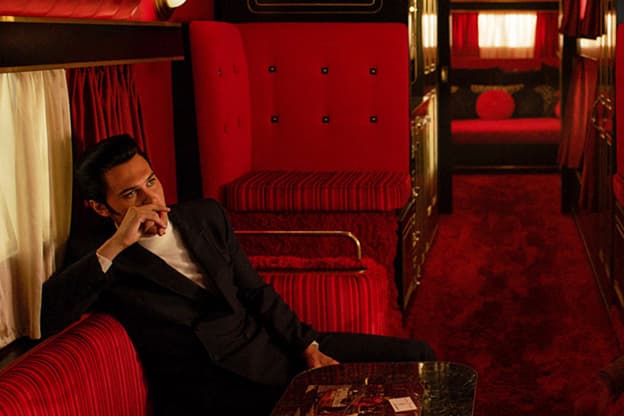
The bus interior presented challenges due to compound curved surfaces requiring custom upholstery. The team used predominantly red fabrics with gold accents and buttoned details to create an opulent interior reflecting the bus as an extension of Elvis's homes and hotels.
Department Structure and Coordination
Bev oversaw a significant department including one assistant set decorator, in-house prop manufacture, scenic artists, three senior and two junior buyers, a set decoration draftsperson, and a large swing gang for set dressing. CM notes that set decoration encompasses all furnishings—chairs, carpets, wallpaper, rugs, curtains—everything that creates the visual environment.
Collaborative Philosophy
The team emphasized that Baz doesn't want to hear "no" but instead expects creative problem-solving. Karen noted that challenges often led to superior solutions. Their long working relationship allowed the team to pivot quickly when issues arose, with CM praising the continuity of vision across departments.
Tags